
Alcohol and Substance Misuse
Alcohol and drugs - Lancashire County Council
Support for young people, parents and carers
Find advice and tips for talking to your children about the risks associated with underage drinking.
YouthZone provides information and advice about drugs and alcohol for young people in Lancashire.
Support for adults
Inspire Lancashire - drug and alcohol support service
Free, confidential support for anyone affected by drugs or alcohol across the county. Whether you want to cut down, stop completely, or get advice for someone else, Inspire can help.
Inspire Lancashire is part of Change Grow Live and works in partnership with local councils and health services to ensure everyone has access to compassionate, person-centred support
They offer:
- One to one and group support for drug and alcohol recovery
- Specialist treatment and harm reduction advice
- Health and wellbeing checks
- Naloxone training and supply
- Community outreach and education
- Free training for professionals and workplaces
How to refer:
Tel: 08081 698 673
Website: www.inspirelancs.org.uk
Recovery Support Service
Red Rose Recovery – commissioned by Lancashire County Council
Offers tailored support to help people rebuild their lives after substance misuse.
Services include:
- Group sessions and one-to-one support
- Community events and volunteering opportunities
To access support, visit one of our Hubs listed below or call 01772 821 440.
Central Lancashire – 33 Lune Street, Preston, PR1 2NN
East Lancashire – St James Old School House, Cannon Street, Accrington BB5 2ER
North Lancashire – 58 Penny Street. Lancaster, LA1 1XF
Website: https://redroserecovery.org.uk/
The Well Communities
A recovery community built on support, inclusion, and lived experience. For over a decade, we’ve helped people across North Lancashire and Cumbria overcome drug and alcohol challenges, rebuild confidence, and move toward healthier, more positive lives.
We offer free, long-term support for anyone facing issues such as addiction, offending, homelessness, mental health challenges, or trauma. Our peer-led approach, backed by professionals and partners, creates a safe space where people can belong, grow, and give back.
At The Well Communities, our community drives our work - because recovery is a journey we take together.
Very Brief Intervention
Ask
We're asking everyone about alcohol, is that okay?
- This question may be promoted from some verbal or visual prompts i.e. the person has stated that they have a hangover or there is evidence of drinking in the home etc.
How often do you have a drink containing alcohol?
- If the answer given indicates around 4 or more times a week you may wish to consider asking how many drinks do they have on each of these occasions, explain that unit measures can be quite confusing and offer to explain a simple unit measurement guide
- The principle behind understanding units and applying these to the guideline is important. Essentially, the greater the dose consumed, the greater the chance of unwanted effects.
This is one unit...
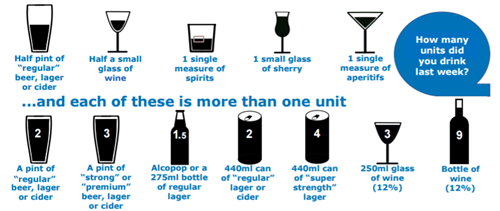
The Chief Medical Officers (CMO) guideline for both men and women states that:
- To keep health risks from alcohol to a low level it is safest not to drink more than 14 units a week on a regular basis
- If you regularly drink as much as 14 units per week, it's best to spread your drinking evenly over three or more days
- If you wish to cut down the amount you drink, a good way to help achieve this is to have several drink-free days a week.
Healthcare professionals are advised to use the questions within the Alcohol Use Disorders Identification Test Consumption (AUDIT C)
Alcohol Use Disorders Identification Test Consumption (AUDIT C)
Assist
State some of many benefits to reducing alcohol intake
- Save Money
- Improved relationships
- Reduce calorie intake/lose weight
- Improved fertility if you are trying for a baby
- Improved sleep
- Reduced risk of injury
- Fewer hangovers
- More alert and higher performing at work
- Reduced risk of high blood presure
- Reduced risk of cancer
- Reduced risk of liver disease
Act
NATIONAL SUPPORT
Do you think you would benefit from some further support to reduce your drinking to 'lower risk' levels?
- Speak to your GP, a loved one or call Drinkline 0300 1231110 (Mon-Fri 9am - 8pm, weekends 11am - 4pm). The Drinkline service provides free, confidential, accurate and consistent information and advice to callers who are concerned about their own or someone else`s drinking regardless of the caller`s age, gender, sexuality, ethnicity or spirituality.
- Want a quick, friendly chat about alcohol? Our trained advisors are on hand to give you some confidential advice. You don't even have to make a phone call. Drinkchat is online between 9am - 2pm (UK time) from Monday to Friday. https://www.drinkaware.co.uk/advice/support-services/chat-with-an-advisor
- Download the 'One You' drinks tracker makes it easy to keep an eye on the booze and take control with daily tips and feedback) available on iTunes or google play.
- Get further information from the NHS www.nhs.uk
SELF CARE
Further tips on cutting down
Make a plan
Before you start drinking, set a limit on how much you're going to drink.
Set a budget
Only take a fixed amount of money to spend on alcohol.
Let them know
If you let your friends and family know you're cutting down and it's important to you, you could get support from them.
Take it a day at a time
Cut back a little each day. That way, every day you do is a success.
Make it a smaller one
You can still enjoy a drink, but go for smaller sizes. Try bottled beer instead of pints, or a small glass of wine instead of a large one.
Have a lower-strength drink
Cut down the alcohol by swapping strong beers or wines for ones with a lower strength (ABV in %). You'll find this information on the bottle.
Stay hydrated
Have a glass of water before you have alcohol and alternate alcoholic drinks with water or a soft drink.
Take a break
Have several drink-free days each week.
Local Support and Contact Details
SPARK
Have you ever:
Felt like you should cut down on your drinking?
Had other people criticise your drinking?
Felt guilty or bad about your drinking?
Needed a drink first thing in the morning to steady your nerves or get rid of a hangover?
Any of these could be a red flag to get some help.
Our services are open access meaning anyone who needs help can get it without an appointment or referral.
If you wish to speak to one of our members of staff, please call 01254 495014 or email us on BWD@calico.org.uk
For young people and families, please contact 0161 723 3880 or email info@earlybreak.co.uk.
To make a referral on behalf of someone else, Spark Referral Form. Spark | Drug & alcohol support services in Blackburn with Darwen
Horizon
The Horizon service is funded by Blackpool Council to provide a wide range of support for all Blackpool residents. We offer information, health screening, treatment and counselling – all confidential and free. Using our dependence to freedom model, we can help you to reduce your dependence on alcohol and drugs or, if you are committed to stopping drinking or using drugs, we can support you on your journey to recovery.
Inspire CGL Lancashire
Alcohol & Substance Misuse: Adults
Central & North Lancashire Contact:
Tel: 08081 698673
Email: CentralNorthLancs.Referrals@cgl.org.uk
East Lancashire Contact:
Tel: 01254 495382
Email: eastlancs.info@cgl.org.uk
Lancashire Website: https://inspirelancs.org.uk/
Welcome to Inspire Lancs Integrated Prevention and Recovery Service.
We provide all aspects of drug and alcohol treatment, including open access, structured treatment and referral to tier 4 rehabilitation. Our aim is to promote recovery from addiction and dependence and support people to make positive changes to their lives.
If you struggle to access our services, whether this is due to childcare, health needs or work commitments, Inspire’s digital team are here to help! Provided you have the technology needed, such as a smart phone or access to a computer, your entire Inspire Journey could be done digitally.
We Are With You in Lancashire (With You), Alcohol & Substance Misuse Services for Young People - Provides recovery and harm reduction for drug and alcohol issues for young people up to 25 years old.
Tel: 0808 164 0074
Websites:
Preston - https://www.wearewithyou.org.uk/services/lancashire-for-young-people-preston/
Lancaster - https://www.wearewithyou.org.uk/services/lancashire-for-young-people-lancaster/
Burnley - https://www.wearewithyou.org.uk/services/lancashire-for-young-people-burnley/
What we offer:
We Are With You in Lancashire (With You) is the specialist children, and young people’s drug and alcohol service for under 25’s. We offer information, advice, guidance and treatment for young people on their drug and alcohol related needs. We are commissioned by Lancashire County Council and cover all areas of Lancashire excluding Blackburn with Darwen, and Blackpool. We offer a blend of one to one and group work, as well as hybrid remote working approaches, using a variety of psychosocial interventions (Motivational Interviewing, Cognitive Behavioural Approaches, and Solution-Focussed Brief Therapy). We offer group work for young people, parents/concerned others, and training for professionals around drugs and alcohol. We also deliver outreach, engaging young people in their own environment. If needed, we offer prescribing for those who require pharmacological interventions.
We see clients in community venues including youth centres, colleges, schools, and CYJS teams with drop-ins at our local bases (Preston, Lancaster, Burnley). We receive referrals from a variety of sources including self, parents, schools, hospitals, children's services and criminal justice.
Volunteering opportunities:
We offer volunteering opportunities and student placements for social work students.
Opening Times: Mon - Fri: 9:00-17:00
CADAS
Our team is available to offer friendly and non-judgemental advice about drug, alcohol use or addictive behaviour, and can provide more intensive support where necessary. Whether you’re worried about yourself, a friend or someone in your family, we are here to help.
If you would you like to chat to someone about your own drug, alcohol use or addictive behaviour, you’re worried about someone else, or you just want some general guidance on how to stay safe – contact us to talk to one of our friendly advisors:
Free CADAS Helpline: 0800 254 5658 (Mon to Fri 11am-5pm, Wednesdays 11am-7pm)
Email: contact@cadas.co.uk
Reception: 0300 111 4002 (Mon-Fri 10am-5pm)
For immediate online support, contact Talk to Frank:
- Live chat: www.talktofrank.com/livechat (2pm to 6pm, 7 days a week)
- Text: 82111 (24 hours a day, 7 days a week)
- Email: frank@talktofrank.com