
Stalking or Harassment
What is stalking and harassment
Stalking
A pattern of Fixated, Obsessive, Unwanted or Repeated behaviour which is intrusive. It can include harassment that amounts to stalking, or stalking that causes fear of violence or serious alarm or distress.
Stalking can consist of any type of behaviour such as regularly sending flowers or gifts, making unwanted or malicious communication, damaging property and physical or sexual assault. If the behaviour is persistent and clearly unwanted, causing you fear, distress or anxiety then it is stalking and you should not have to live with it.
Further info: https://library.college.police.uk/docs/appref/Stalking-or-harassment-advice-for-investigators.pdf
Harassment
Harassment is unwanted behaviour which the individual subjected to such behaviour finds offensive or which makes them feel intimidated or humiliated. It can happen on its own or alongside other forms of discrimination. It’s harassment if the unwanted behaviour has happened more than once.
Harassment could be:
- bullying at school or in the workplace
- cyber stalking (using the internet to harass someone)
- antisocial behaviour
- sending abusive text messages
- sending unwanted gifts
- unwanted phone calls, letters, emails or visits
A victim of harassment does not need to have previously objected to something for it to be unwanted. If someone behaves in a way which makes an individual feel distressed, intimidated or offended and the behaviour is of a sexual nature, this is called sexual harassment.
The Difference between Stalking and Harassment
The difference between stalking and harassment is FOUR. stalking cases will have evidence of: Fixation, Obsessiveness, Unwanted, Repeated behaviour.
Stalking – a fixation on the individual, may present as multiple issues with the person, but at the core is the about the victim.
Harassment –about a specific issue, if the issue wasn’t there the contact would stop.
Sexual harassment is unlawful, as a form of discrimination, under the Equality Act 2010.
Further info: https://www.police.uk/advice/advice-and-information/sh/stalking-harassment/what-is-stalking-harassment
Online stalking and harassment
Social networking sites, chat rooms, gaming sites and other forums are often used to stalk and harass someone, for example:
- to get personal information
- to communicate (calls, texts, emails, social media, creating fake accounts)
- damaging the reputation
- spamming and sending viruses
- tricking other internet users into harassing or threatening
- identity theft
- threats to share private information, photographs, copies of messages
Further info: https://www.police.uk/advice/advice-and-information/sh/stalking-harassment/what-is-stalking-harassment/
https://library.college.police.uk/docs/college-of-policing/Stalking-and-Harassment-2020.pdf
Very Brief Intervention
Ask
In accordance with the ‘College of Policing – Advice to police responders to ensure an effective response to reports of stalking or harassment’ the primary task of the first responder is to make people safe. The below flowchart advises on the steps which should be taken:
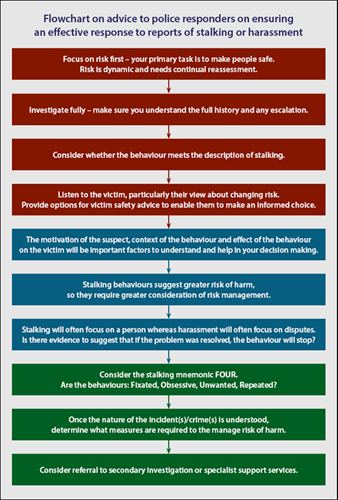
Consider asking these stalking screening questions:
Are you frightened?
Are you worried about your safety?
Has the suspect previously stalked or harassed you?
Does the suspect repeatedly visit you at work, home etc, more than three times a week?
Has the suspect made any threats of physical or sexual violence towards you in the current stalking/harassment incident?
Has the suspect loitered around your home/workplace etc?
Has the suspect ever destroyed or vandalised your property?
Has the suspect given any threats of harm or violence?
How have you responded to the suspect?
What is the duration of this behaviour?
More info on screening questions: https://library.college.police.uk/docs/college-of-policing/Stalking-and-Harassment-2020.pdf
Assist
The College of Policing guidance lists the following actions which should be taken once stalking or harassment has been reported:
Reassure the person that they have a right to feel safe in your home and workplace
What initial action should I take?
- Early identification and intervention
- Use professional curiosity
- Understand the wider behaviour
- Consider mental ill health
- Safeguard the victim
- Gather appropriate evidence
- Consider eligibility for enhanced services
- Check wider sources of information
Note: Victims who are persistently targeted over a period of time, particularly those subjected to a sustained campaign of harassment or stalking, will be entitled to an enhanced service.
Potential safe‑guarding tactics Officers could consider:
- Arrest and remand in custody or appropriate bail conditions.
- Emergency mobile phone.
- Neighbourhood watch.
- Alerting friends, family or employers to risks.
- Panic alarm.
- Use of covert cameras.
- Address flagging on call handling systems and the PNC.
- If it is necessary to seize a victim’s mobile phone to gather evidence, consideration should be given to providing them with a replacement.
Preventing further offending and harm
- Look for where the perpetrator has opportunities to stalk or harass the victim and put preventative measures into action
- Officers should discuss and develop and appropriate risk management plan with the victim
- Ensure any safeguarding activity does not further isolate the victim
- Any activity to mediate between parties needs careful consideration and may be wholly inappropriate.
- Consider a Stalking Protection Order (SPO) as a means of managing an alleged suspect through the use of prohibitions and/or positive requirements, as well as imposing notifying requirements on the suspect.
SPO-Briefing-sheet-for-practitioners-v1.1.pdf
Online Stalking or Harassment
It is highly likely that there will be online behaviours connected to the stalking or harassment, for example hacking into a victim’s social media, email or other online accounts, placing tracking or monitoring software onto cars, phones or other devices, etc.
Digital safety advice for victims might include:
- Check for spyware, malware apps or tracking devices.
- Provide the victim with a digital safety advice hand-out and link to Get Safe Online.
- Ensure or adjust privacy settings.
- Remove geotagging facilities and ask friends not to tag them on social media.
- Keep shared information safe
- Do not reveal addresses, phone numbers and ask friends to do the same
- Avoid discussing the suspect online or with anyone who might pass on information
- Do not reveal personal information you do not want the suspect to know e.g. new relationship, job, etc
- Create random passwords
Further info: https://library.college.police.uk/docs/college-of-policing/Stalking-and-Harassment-2020.pdf
Act
National Support Services
- If you need to report an incident of stalking call 101. Report it as early as possible to the police and tell others what is happening
- If you are in danger dial 999
Operated by the Suzy Lamplugh Trust, the National Stalking Helpline gives practical information, support, and advice on risk, safety planning and legislation to victims of stalking, their friends, family, and professionals working with victims.
If you use the telephone service, you will get through to a Helpline advisor who will explain our confidentiality policy and ask for details about what has been happening to you so that they can provide guidance and information.
Among other things, the Helpline advisor will probably ask you if you have been to the police and how you are currently feeling. If we ask a question that is too personal then you do not need to answer it. The Helpline advisor will then give you information and advice that you may or may not decide to follow. If you have mentioned an issue that we do not feel we can accurately give information on, we may give you the details of another service to contact.
If you contact the helpline via our online form, a Helpline Advisor will respond to you by email. We endeavor to respond to all online contact as soon as possible, but please be aware the demand for our service is very high. If you need advice quickly, we would suggest you call the helpline.
OPENING HOURS:
09:30 - 20:00, Monday and Wednesday
09:30 - 16:00, Tuesday, Thursday, Friday
FREEPHONE:
0808 802 0300
The Helpline is not open on weekends or bank holidays.
Website: https://www.suzylamplugh.org/stalking-help-and-advice
Paladin provides a high level of advocacy to anyone at risk of serious harm or homicide from a stalker. We give initial advice and offer to complete a detailed assessment to anyone who calls our service and is affected by stalking
Tel:020 38664107
Web: https://www.paladinservice.co.uk/
Protection Against Stalking is a national charity working within communities to raise public awareness about stalking and support victims of stalking through providing specialist support services. We form part of a national consortium of specialist stalking charities who share best practice and work cooperatively where it is appropriate.
If you feel you are being stalked and in immediate danger – call 999
If you believe you are being stalked, but not in immediate danger, contact support@protectionagainststalking.org
Website: https://www.protectionagainststalking.org/
Citizen’s advice can provide advice on your legal rights if you feel like you’re experiencing sexual harassment at work.
Tel: 0800 144 8848
Website: citizensadvice.org.uk
We are a UK service supporting adults (aged 18+) who are experiencing intimate image abuse, also known as, revenge porn.
The Helpline was established in 2015 alongside the legislation which made it an offence to share intimate images or videos of someone, either on or offline, without their consent with the intention of causing distress. The Helpline is run by a small team of passionate and motivated individuals who are here and ready to help.
The Helpline can assist you with:
- Non-judgemental and confidential advice
- Reporting and removal of content
- Social media advice
- Reporting to the police
- Legal advice
Telephone: 0345 6000 459 – Monday to Friday 10am-4pm (excluding bank holidays)
Email: help@revengepornhelpline.org.uk
Website: https://revengepornhelpline.org.uk/
Home | Rights of Women – Helping women through the law
We give free employment legal advice to women in England and Wales experiencing sexual harassment at work including:
- Identifying sexual harassment
- Reporting sexual harassment to your employer
- Advice about grievances and investigations
- The Employment Tribunal procedure
- Settlement Agreements and Non-Disclosure Agreements
- Reporting sexual harassment to professional regulators and the EHRC
Telephone: 020 7490 0152 – Monday, Tuesday and Wednesday 6pm to 8pm – Thursdays and Fridays 10am to 12pm
Victim Support is an independent charity dedicated to supporting victims of crime and traumatic incidents in England and Wales.
We provide specialist help to support people to cope and recover to the point where they feel they are back on track with their lives. As with all crimes, we can give you both practical help and advice, and the emotional support you need to cope and recover from stalking.
24/7 Supportline – 08 08 16 89 111
24/7 Online Live Chat: https://www.victimsupport.org.uk/help-and-support/get-help/support-near-you/live-chat/
Website: https://www.victimsupport.org.uk/
Local Support and Contact Details
Victim Support Humberside. We're commissioned by Humberside Police and Crime Commissioner. If you’ve been affected by crime, we can give you the support you need to move forward. Our services are free, confidential and available to anyone in England and Wales, regardless of whether the crime has been reported or how long ago it happened. Choose from a number of ways to contact us.
Tel: 0800 368 7586. Lines are open 8am – 6pm Monday to Friday.
MS bookings is a system that we currently use at Victim Support to provide a victim with flexibility and choice in when they have contact with a Caseworker. We want to extend this specifically for victims of non-DA stalking to ensure that they can be referred in to and receive contact with an Independent Stalking Advocate (ISAC) as quickly as possible after they report to Police.
The below link would be for Officers to access when with a victim, either face to face or on the telephone, to support them to book this first appointment with an ISAC. You will see when clicking on the link that only basic information is required from the Officer when they access this, including the personal details of victim, contact information and a brief description of the crime/circumstances. The calendar gives information on future dates and times that an appointment can be booked, and the Officer can agree this with the victim and book it on the same page on the link. There is an option for the victim to state if they would prefer the ISAC to contact via telephone call or a Zoom video call.
Once an Officer completes the information, the appointment booking information will then come through to our ISAC team who will pick it up and contact the victim at the booked time using their preferred method.
The MS bookings system allows victims to feel more in control following the first contact with Police as they will know when they can expect contact in relation to support. We can also ensure that our ISACs are contacting at a time that is safe and convenient for them, making them more likely to engage in support.
We appreciate how busy Officers are, and this way should also be quicker and more convenient to do at the time of contact with the victim than completing our ISAC referral form.
Caseworker booking service: Stalking and Hate Crime
Tel: 0300 303 1976 (Monday to Friday 9am-8pm and Saturday 9am-1pm)
Out of Hours 24/7 Support line – 08 08 16 89 111
Website - Humberside - Victim Support
Safecall Helpline
Safecall Helpline is a service for 11-17 year olds run by the charity Missing People.
Safecall Helpline is here if you are thinking about running away, if you have already run away, or if you have been away and come back. This includes for reasons due to harassment or bullying that a young person may have experienced.
SafeCall allows young people to get in touch via phone call/ text: 116000, or online chat. The anonymous service is available every day during these operating times:
- Call – 10am – 5pm
- SMS – 10am – 10pm
- Online chat – 5:30pm – 10pm
Protection Against Stalking is a national charity working within communities to raise public awareness about stalking and support victims of stalking through providing specialist support services. We form part of a national consortium of specialist stalking charities who share best practice and work cooperatively where it is appropriate.
If you feel you are being stalked and in immediate danger – call 999
If you believe you are being stalked, but not in immediate danger, contact support@protectionagainststalking.org
Website: https://www.protectionagainststalking.org/
Citizen’s advice can provide advice on your legal rights if you feel like you’re experiencing sexual harassment at work.
Tel: 0800 144 8848
Website: citizensadvice.org.uk