
Sexual Abuse
Sexual Abuse
Rape and Sexual Assault
A sexual assault is any sexual act that a person did not consent to, or is forced into against their will. It is a form of sexual violence and includes rape (an assault involving penetration of the vagina, anus or mouth), or other sexual offences, such as groping, forced kissing, child sexual abuse or the torture of a person in a sexual manner.
All cases of rape or sexual assault will be different. It is not uncommon for a victim of sexual assault to have no physical injuries or signs of their assault. But sexual assault is still a crime and can be reported to the police in the same way as other crimes. In all cases officers should do their best to minimise trauma and offer support for as long as a victim would like, including offering support from other agencies.
The Crime Survey for England and Wales for the year ending March 2025 showed that police recorded 209,556 sexual offences, encompassing rape (71,667 cases) and sexual assault, and also sexual activity with children.
Most sexual assaults are carried out by someone known to the victim. This could be a partner, former partner, relative, friend or colleague. The assault may happen in many places but is usually in the victim's home or the home of the alleged perpetrator (the person carrying out the assault).
Very Brief Intervention
Ask
Sexual Abuse
Rape and Sexual Assault
For police first responders to a report of rape or sexual assault your priorities are to make anyone you identify as vulnerable, safe and begin an investigation into the report of rape and sexual assault.
As the first responder, you are likely to hear the victim’s account first. Whether the report is about something that is recent or non-recent, the victim may still be traumatised. Your manner with the victim will be important for an appropriate and empathetic response.
There are many reasons why victims don’t report or delay reporting rape or sexual assault. It can be because they fear they will not be believed or will be blamed or judged for their actions, or they fear repercussions from the suspect or family for reporting. In all cases, it is important to:
- Ensure the victim’s safety, understanding any risk posed by the perpetrator to the victim or other people
Do you feel you are still in danger? Do you have a safe place to go?
Can we call someone for you who can support you?
- Identify any immediate medical needs
Do you need medical attention?
- Initiate the investigation and consider evidence preservation from the outset
- Reassure the victim that they have done the right thing in coming forward and reporting
- Be non-judgemental
- Show empathy and sensitivity
- Maintain impartiality
- Identify if an interpreter or registered intermediary is required
- Speak to the victim in an environment in which they are comfortable
- Understand that rape and sexual offences in intimate/ex-intimate partner relationships may occur as part of a pattern of coercive or controlling behaviour or stalking and seek evidence connected with either of these offences
- Remember that many victims may be under the age of 18 and are therefore still children and need to be dealt with in accordance with current Working Together to Safeguard Children guidance and APP (authorised professional practice) on child abuse investigation.
Assist
Once you have established the particular circumstances and needs of the individual what can you do to help?
Please click on regional police force links at the bottom of the page for guidance and information about how you may assist and support victims of sexual violence and child sexual exploitation locally.
Rape and Sexual Assault
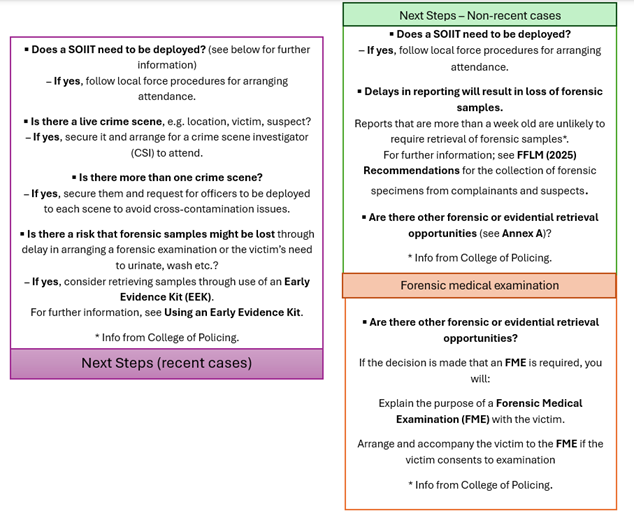
College of Policing guidance about how to progress a report of Sexual Assault:
Rape and sexual offences | College of Policing
Child Sexual Exploitation
Child Sexual Exploitation is not a specific criminal offence. It encompasses a range of different forms of serious criminal conduct and a number of individual offences.
In assessing whether a child or young person is a victim, or at risk of becoming a victim, of sexual exploitation, careful consideration should be given to the following:
- a child under the age of 13 is not legally capable of consenting to sex (it is statutory rape) or any other type of sexual touching
- sexual activity with a child under 16 is an offence
- it is an offence for a person to have a sexual relationship with a 16 or 17-year-old if they hold a position of trust or authority in relation to them
- where sexual activity with a 16 or 17-year-old does not result in an offence being committed, it may still result in harm or the likelihood of harm being suffered
- non-consensual sex is rape, whatever the age of the victim
- if the victim is incapacitated through drink or drugs, or the victim, or his or her family, has been subjected to violence or the threat of it, they cannot be considered to have given true consent and, therefore, offences may have been committed
- CSE is an issue for all children under the age of 18 years and not limited to those in a specific age group.
CSE investigations require a proactive approach to explore the nature and patterns of sexual exploitation locally, and to share information with partner agencies about those at risk and potential offenders.
Act
National Support Services
Rape and Sexual Assault
Rape Crisis England and wales
Tel: 0808 500 2222. Open 24/7 every day of the year
National Women’s Aid England - Information about support services for women experiencing domestic violence.
Tel: 0117 944 4411 | 24-hour domestic violence helpline: 0808 2000 247
Revenge Porn Helpline
UK service supporting adults (aged 18+) who are experiencing intimate image abuse, also known as, revenge porn. Self-referral and Professional referral - signposting only
Tel: 0345 6000 459 Monday to Friday (excluding bank holidays) - 10:00 to 16:00
Email: help@revengepornhelpline.org.uk
Web: https://revengepornhelpline.org.uk/
The Survivors Trust - Support for victims/survivors of rape, sexual violence and childhood sexual abuse. working with women, men and children.
Tel: 08088 010 818.
Monday – Thursday: 10am-12.30pm, 1.30pm-3pm & 6pm-8pm
Friday: 10am – 12.30pm & 1.30pm – 3pm
Saturday: 10am – 12.30pm
Sunday: 6pm – 8pm Bank holidays: 10am – 12.30pm
Safeline - National helpline to support male victims of rape and sexual abuse.
Tel: 0808 800 5005. Open office hours except Weds and Sundays.
Local Support and Contact Details
Humberside Police
How HP deal with reports of rape or sexual assault
Sexual Assault Referral Centres - A Sexual Assault Referral Centre (SARC) is a "one stop" location, where specially trained staff can offer medical, practical and emotional support to those who have experienced sexual violence or sexual abuse. In addition to accessing services via the police, clients also have the option to self-refer if they do not want police involvement.
Humberside – Casa Suite SARC (Hull) 0330 223 0099
Email: casasuite.sarc@nhs.net (for non-urgent queries – the email inbox is not monitored out of hours, but they will get back to you as soon as possible)
Address: CASA Suite SARC, 810A Hessle Road, Hull, East Riding of Yorkshire, HU4 6RD
Website: https://www.casasuite.org/
Other Useful contacts
South Yorkshire Sexual Assault Referral Centre – 0330 223 0938
Victim Support Service Humberside
Tel: 0800 368 7586 Monday to Friday 9am-6pm.
For support outside opening hours, call 24/7 Support line for free on 08 08 16 89 111
Email: humberside@victimsupport.org.uk
Hull Rape Crisis and Sexual Support Service - Counselling, Crisis Support/Information, Helpline, Outreach for women
Tel: 01482 329990 09.30am to 4.00pm (24hr answer service)
The Blue Door - Advocacy, Counselling, Crisis Support, Group Work and helpline for men, women, young people
Tel: Helpline: 0800 197 4787 Office: 01724 841947
Email: info@thebluedoor.org
Website: https://www.thebluedoor.org/